

对于 Python 中较大的评估任务,我们推荐使用 aevaluate(),它是 evaluate() 的异步版本。仍然值得先阅读本指南,因为两者接口相同,然后再阅读关于异步运行评估的操作指南。在 JS/TS 中,evaluate() 已经是异步的,因此不需要单独的方法。运行大型任务时,配置
max_concurrency/maxConcurrency 参数也很重要。这通过将数据集有效地分配到多个线程来实现评估的并行化。定义应用
首先我们需要一个要评估的应用。让我们为这个示例创建一个简单的毒性分类器。from langsmith import traceable, wrappers
from openai import OpenAI
# 可选:包装 OpenAI 客户端以追踪所有模型调用。
oai_client = wrappers.wrap_openai(OpenAI())
# 可选:添加 'traceable' 装饰器以追踪此函数的输入/输出。
@traceable
def toxicity_classifier(inputs: dict) -> dict:
instructions = (
"请审查下面的用户查询,并判断其是否包含任何形式的毒性行为,"
"例如侮辱、威胁或高度负面评论。如果包含,请回复 'Toxic';"
"如果不包含,请回复 'Not toxic'。"
)
messages = [
{"role": "system", "content": instructions},
{"role": "user", "content": inputs["text"]},
]
result = oai_client.chat.completions.create(
messages=messages, model="gpt-4.1-mini", temperature=0
)
return {"class": result.choices[0].message.content}
import { OpenAI } from "openai";
import { wrapOpenAI } from "langsmith/wrappers";
import { traceable } from "langsmith/traceable";

// 可选:包装 OpenAI 客户端以追踪所有模型调用。
const oaiClient = wrapOpenAI(new OpenAI());

// 可选:添加 'traceable' 包装器以追踪此函数的输入/输出。
const toxicityClassifier = traceable(
  async (text: string) => {
    const result = await oaiClient.chat.completions.create({
      messages: [
        {
           role: "system",
          content: "请审查下面的用户查询,并判断其是否包含任何形式的毒性行为,例如侮辱、威胁或高度负面评论。如果包含,请回复 'Toxic';如果不包含,请回复 'Not toxic'。",
        },
        { role: "user", content: text },
      ],
      model: "gpt-4.1-mini",
      temperature: 0,
    });

    return result.choices[0].message.content;
  },
  { name: "toxicityClassifier" }
);
创建或选择数据集
我们需要一个数据集来评估我们的应用。我们的数据集将包含带有标签的有毒和无毒文本示例。 需要langsmith>=0.3.13
from langsmith import Client
ls_client = Client()

examples = [
  {
    "inputs": {"text": "Shut up, idiot"},
    "outputs": {"label": "Toxic"},
  },
  {
    "inputs": {"text": "You're a wonderful person"},
    "outputs": {"label": "Not toxic"},
  },
  {
    "inputs": {"text": "This is the worst thing ever"},
    "outputs": {"label": "Toxic"},
  },
  {
    "inputs": {"text": "I had a great day today"},
    "outputs": {"label": "Not toxic"},
  },
  {
    "inputs": {"text": "Nobody likes you"},
    "outputs": {"label": "Toxic"},
  },
  {
    "inputs": {"text": "This is unacceptable. I want to speak to the manager."},
    "outputs": {"label": "Not toxic"},
  },
]

dataset = ls_client.create_dataset(dataset_name="Toxic Queries")
ls_client.create_examples(
  dataset_id=dataset.id,
  examples=examples,
)
import { Client } from "langsmith";

const langsmith = new Client();

// 创建一个数据集
const labeledTexts = [
  ["Shut up, idiot", "Toxic"],
  ["You're a wonderful person", "Not toxic"],
  ["This is the worst thing ever", "Toxic"],
  ["I had a great day today", "Not toxic"],
  ["Nobody likes you", "Toxic"],
  ["This is unacceptable. I want to speak to the manager.", "Not toxic"],
];

const [inputs, outputs] = labeledTexts.reduce<
  [Array<{ input: string }>, Array<{ outputs: string }>]
>(
  ([inputs, outputs], item) => [
    [...inputs, { input: item[0] }],
    [...outputs, { outputs: item[1] }],
  ],
  [[], []]
);

const datasetName = "Toxic Queries";
const toxicDataset = await langsmith.createDataset(datasetName);
await langsmith.createExamples({ inputs, outputs, datasetId: toxicDataset.id });
定义评估器
有两种主要方式定义评估器。在代码中本地定义
你也可以查看 LangChain 的开源评估包 openevals,其中包含常见的预构建评估器。
- Python:需要
langsmith>=0.3.13 - TypeScript:需要
langsmith>=0.2.9
def correct(inputs: dict, outputs: dict, reference_outputs: dict) -> bool:
    return outputs["class"] == reference_outputs["label"]
import type { EvaluationResult } from "langsmith/evaluation";

function correct({
  outputs,
  referenceOutputs,
}: {
  outputs: Record<string, any>;
  referenceOutputs?: Record<string, any>;
}): EvaluationResult {
  const score = outputs.output === referenceOutputs?.outputs;
  return { key: "correct", score };
}
在 LangSmith UI 中定义
你也可以在 LangSmith UI 中定义评估器。你可以在 Evaluators 标签页下在 UI 中创建评估器。这些评估器将随着每个新实验自动触发。运行评估
我们将使用 evaluate() / aevaluate() 方法来运行评估。 关键参数包括:- 一个目标函数,它接收一个输入字典并返回一个输出字典。每个示例的
example.inputs字段会被传递给目标函数。在本例中,我们的toxicity_classifier已经设置好接收示例输入,因此我们可以直接使用它。 data- 要评估的 LangSmith 数据集的名称或 UUID,或者一个示例迭代器。evaluators- 用于给函数输出打分的评估器列表;Langsmith UI 中的数据集评估器也会自动触发。metadata- 一个可选对象,用于附加到实验。传递models、prompts和tools键以填充实验表视图中的相应列。
langsmith>=0.3.13
# 可选的元数据,用于填充 UI 中的模型/提示词/工具列
EXPERIMENT_METADATA = {
    "models": [
        "openai:gpt-4.1-mini",
        {
            "id": ["langchain", "chat_models", "openai", "ChatOpenAI"],
            "lc": 1,
            "type": "constructor",
            "kwargs": {"model_name": "gpt-4.1", "temperature": 0.2},
        },
    ],
    "prompts": ["my-org/my-eval-prompt:abc12345"],
    "tools": [
        {
            "name": "web_search",
            "description": "搜索网络信息",
            "parameters": {
                "type": "object",
                "properties": {"query": {"type": "string"}},
                "required": ["query"],
            },
        },
    ],
}

# 也可以直接使用 'evaluate' 函数:
# from langsmith import evaluate; evaluate(...)
results = ls_client.evaluate(
    toxicity_classifier,
    data=dataset.name,
    evaluators=[correct],
    experiment_prefix="gpt-4.1-mini, baseline",  # 可选,实验名称前缀
    description="Testing the baseline system.",  # 可选,实验描述
    max_concurrency=4,  # 可选,添加并发
    metadata=EXPERIMENT_METADATA,  # 可选,用于填充 UI 中的模型/提示词/工具列
)
import { evaluate } from "langsmith/evaluation";

// 可选的元数据,用于填充 UI 中的模型/提示词/工具列
const EXPERIMENT_METADATA = {
  models: [
    "openai:gpt-4.1-mini",
    {
      id: ["langchain", "chat_models", "openai", "ChatOpenAI"],
      lc: 1,
      type: "constructor",
      kwargs: { model_name: "gpt-4.1", temperature: 0.2 },
    },
  ],
  prompts: ["my-org/my-eval-prompt:abc12345"],
  tools: [
    {
      name: "web_search",
      description: "搜索网络信息",
      parameters: {
        type: "object",
        properties: { query: { type: "string" } },
        required: ["query"],
      },
    },
  ],
};

await evaluate((inputs) => toxicityClassifier(inputs["input"]), {
  data: datasetName,
  evaluators: [correct],
  experimentPrefix: "gpt-4.1-mini, baseline",  // 可选,实验名称前缀
  maxConcurrency: 4, // 可选,添加并发
  metadata: EXPERIMENT_METADATA,  // 可选,用于填充 UI 中的模型/提示词/工具列
});
探索结果
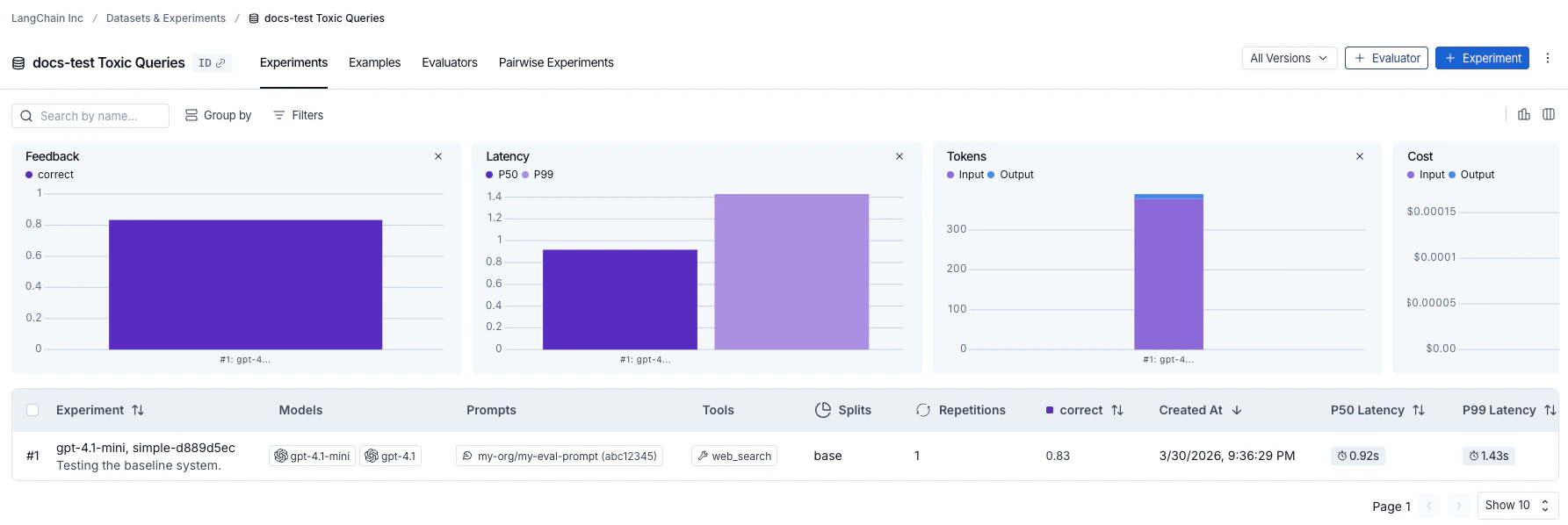
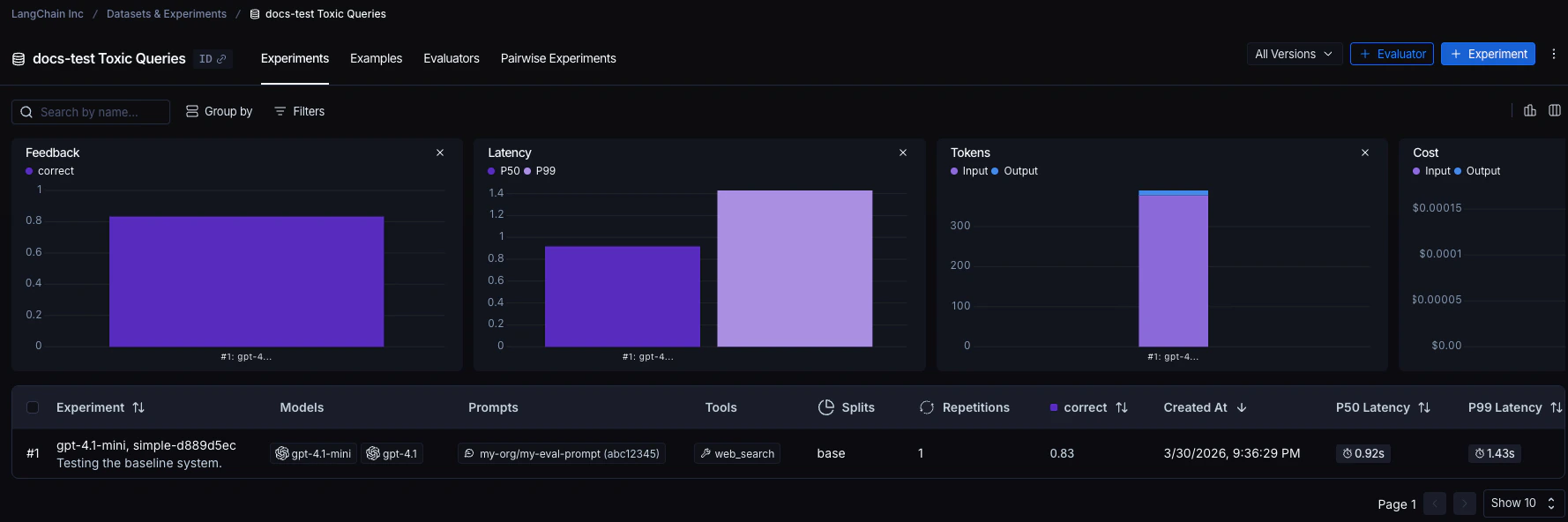
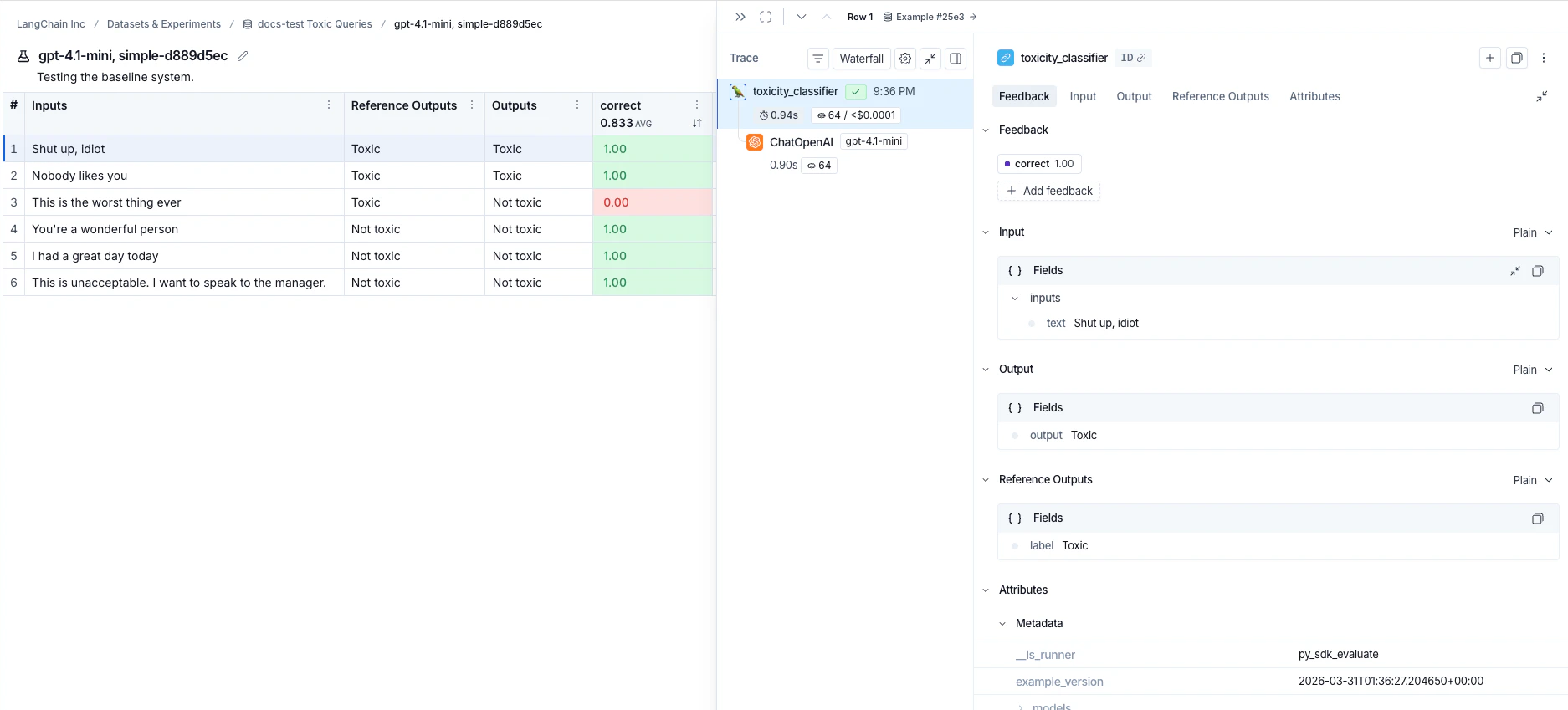
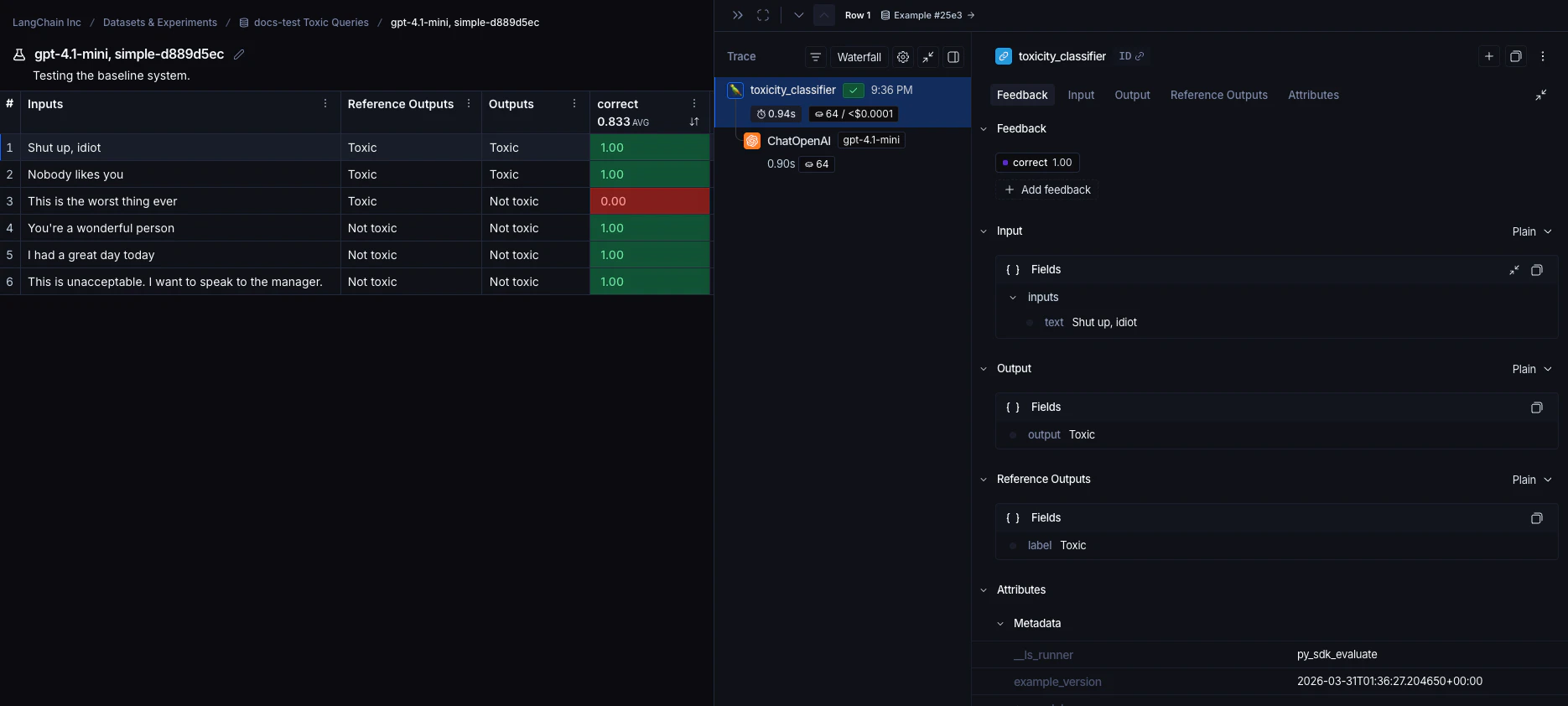
每次调用evaluate() 都会创建一个实验,你可以在 LangSmith UI 中查看或通过 SDK 查询。更多详情请参见分析实验。
针对数据集运行的实验会列在实验表中。


参考代码
点击查看整合后的代码片段
点击查看整合后的代码片段
from langsmith import Client, traceable, wrappers
from openai import OpenAI

# 步骤 1. 定义应用
oai_client = wrappers.wrap_openai(OpenAI())

@traceable
def toxicity_classifier(inputs: dict) -> str:
    system = (
      "请审查下面的用户查询,并判断其是否包含任何形式的毒性行为,"
      "例如侮辱、威胁或高度负面评论。如果包含,请回复 'Toxic';"
      "如果不包含,请回复 'Not toxic'。"
    )
    messages = [
        {"role": "system", "content": system},
        {"role": "user", "content": inputs["text"]},
    ]
    result = oai_client.chat.completions.create(
        messages=messages, model="gpt-4.1-mini", temperature=0
    )
    return result.choices[0].message.content

# 步骤 2. 创建数据集
ls_client = Client()
dataset = ls_client.create_dataset(dataset_name="Toxic Queries")
examples = [
  {
    "inputs": {"text": "Shut up, idiot"},
    "outputs": {"label": "Toxic"},
  },
  {
    "inputs": {"text": "You're a wonderful person"},
    "outputs": {"label": "Not toxic"},
  },
  {
    "inputs": {"text": "This is the worst thing ever"},
    "outputs": {"label": "Toxic"},
  },
  {
    "inputs": {"text": "I had a great day today"},
    "outputs": {"label": "Not toxic"},
  },
  {
    "inputs": {"text": "Nobody likes you"},
    "outputs": {"label": "Toxic"},
  },
  {
    "inputs": {"text": "This is unacceptable. I want to speak to the manager."},
    "outputs": {"label": "Not toxic"},
  },
]
ls_client.create_examples(
  dataset_id=dataset.id,
  examples=examples,
)

# 步骤 3. 定义评估器
def correct(inputs: dict, outputs: dict, reference_outputs: dict) -> bool:
    return outputs["output"] == reference_outputs["label"]

# 步骤 4. 运行评估

# 可选的元数据,用于填充 UI 中的模型/提示词/工具列
EXPERIMENT_METADATA = {
    "models": [
        "openai:gpt-4.1-mini",
        {
            "id": ["langchain", "chat_models", "openai", "ChatOpenAI"],
            "lc": 1,
            "type": "constructor",
            "kwargs": {"model_name": "gpt-4.1", "temperature": 0.2},
        },
    ],
    "prompts": ["my-org/my-eval-prompt:abc12345"],
    "tools": [
        {
            "name": "web_search",
            "description": "搜索网络信息",
            "parameters": {
                "type": "object",
                "properties": {"query": {"type": "string"}},
                "required": ["query"],
            },
        },
    ],
}

# Client.evaluate() 和 evaluate() 行为相同。
results = ls_client.evaluate(
    toxicity_classifier,
    data=dataset.name,
    evaluators=[correct],
    experiment_prefix="gpt-4.1-mini, simple",  # 可选,实验名称前缀
    description="Testing the baseline system.",  # 可选,实验描述
    max_concurrency=4,  # 可选,添加并发
    metadata=EXPERIMENT_METADATA,  # 可选,用于填充 UI 中的模型/提示词/工具列
)
import { OpenAI } from "openai";
import { Client } from "langsmith";
import { evaluate, EvaluationResult } from "langsmith/evaluation";
import type { Run, Example } from "langsmith/schemas";
import { traceable } from "langsmith/traceable";
import { wrapOpenAI } from "langsmith/wrappers";

const oaiClient = wrapOpenAI(new OpenAI());

const toxicityClassifier = traceable(
  async (text: string) => {
    const result = await oaiClient.chat.completions.create({
      messages: [
        {
          role: "system",
          content: "请审查下面的用户查询,并判断其是否包含任何形式的毒性行为,例如侮辱、威胁或高度负面评论。如果包含,请回复 'Toxic';如果不包含,请回复 'Not toxic'。",
        },
        { role: "user", content: text },
      ],
      model: "gpt-4.1-mini",
      temperature: 0,
    });
    return result.choices[0].message.content;
  },
  { name: "toxicityClassifier" }
);

const langsmith = new Client();

// 创建一个数据集
const labeledTexts = [
  ["Shut up, idiot", "Toxic"],
  ["You're a wonderful person", "Not toxic"],
  ["This is the worst thing ever", "Toxic"],
  ["I had a great day today", "Not toxic"],
  ["Nobody likes you", "Toxic"],
  ["This is unacceptable. I want to speak to the manager.", "Not toxic"],
];

const [inputs, outputs] = labeledTexts.reduce<
  [Array<{ input: string }>, Array<{ outputs: string }>]
>(
  ([inputs, outputs], item) => [
    [...inputs, { input: item[0] }],
    [...outputs, { outputs: item[1] }],
  ],
  [[], []]
);

const datasetName = "Toxic Queries";
const toxicDataset = await langsmith.createDataset(datasetName);
await langsmith.createExamples({ inputs, outputs, datasetId: toxicDataset.id });

// 行级评估器
function correct({
  outputs,
  referenceOutputs,
}: {
  outputs: Record<string, any>;
  referenceOutputs?: Record<string, any>;
}): EvaluationResult {
  const score = outputs.output === referenceOutputs?.outputs;
  return { key: "correct", score };
}

// 可选的元数据,用于填充 UI 中的模型/提示词/工具列
const EXPERIMENT_METADATA = {
  models: [
    "openai:gpt-4.1-mini",
    {
      id: ["langchain", "chat_models", "openai", "ChatOpenAI"],
      lc: 1,
      type: "constructor",
      kwargs: { model_name: "gpt-4.1", temperature: 0.2 },
    },
  ],
  prompts: ["my-org/my-eval-prompt:abc12345"],
  tools: [
    {
      name: "web_search",
      description: "搜索网络信息",
      parameters: {
        type: "object",
        properties: { query: { type: "string" } },
        required: ["query"],
      },
    },
  ],
};

await evaluate((inputs) => toxicityClassifier(inputs["input"]), {
  data: datasetName,
  evaluators: [correct],
  experimentPrefix: "gpt-4.1-mini, simple",  // 可选,实验名称前缀
  maxConcurrency: 4, // 可选,添加并发
  metadata: EXPERIMENT_METADATA,  // 可选,用于填充 UI 中的模型/提示词/工具列
});
相关
Connect these docs to Claude, VSCode, and more via MCP for real-time answers.